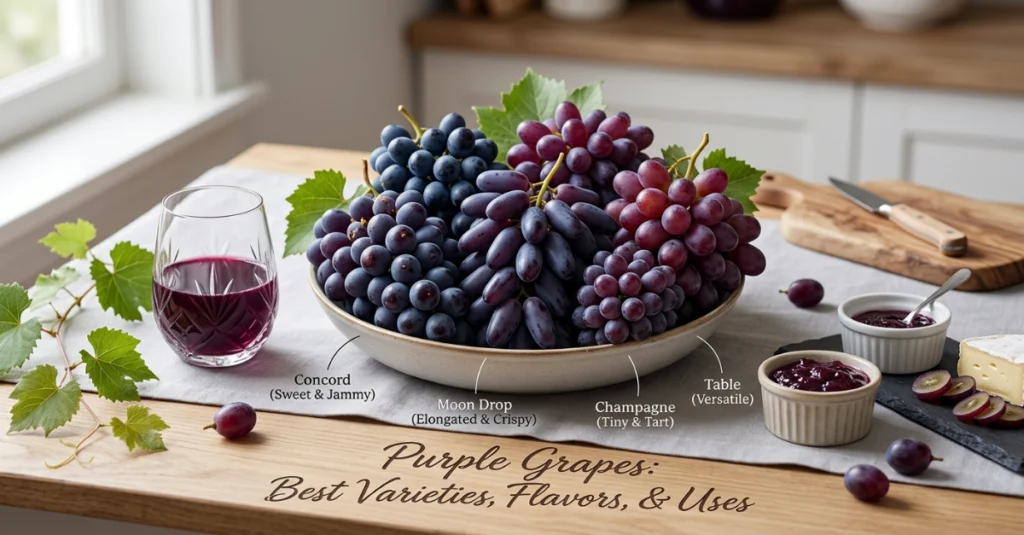
You pick up a bunch of purple grapes at the store, and assume they’re all the same; they’re not. A Concord grape and a Kyoho grape share the same deep color but taste completely different, grow on opposite sides of the world, and serve entirely different purposes in the kitchen. Choosing the right purple grape variety changes everything from the flavor in your fruit bowl to the quality of your homemade jelly.
This guide covers the 8 best types of purple grapes, what each one tastes like, and exactly when and how to use them. If you already want to understand what makes purple grapes such a powerful health food, knowing which variety to buy makes that nutritional advantage even more accessible.
- What Qualifies as a Purple Grape?
- The 8 Best Purple Grape Varieties
- Purple Grape Variety Comparison Table
- How to Pick the Right Purple Grape for Your Needs
- Green vs. Purple Grapes: What’s the Real Difference?
- When Do Purple Grapes Come Into Season?
- Where to Buy Authentic Purple Grape Varieties
- Can Dogs Eat Purple Grapes?
- Purple Grape Juice vs. Whole Purple Grapes
- Conclusion
- FAQ's
What Qualifies as a Purple Grape?
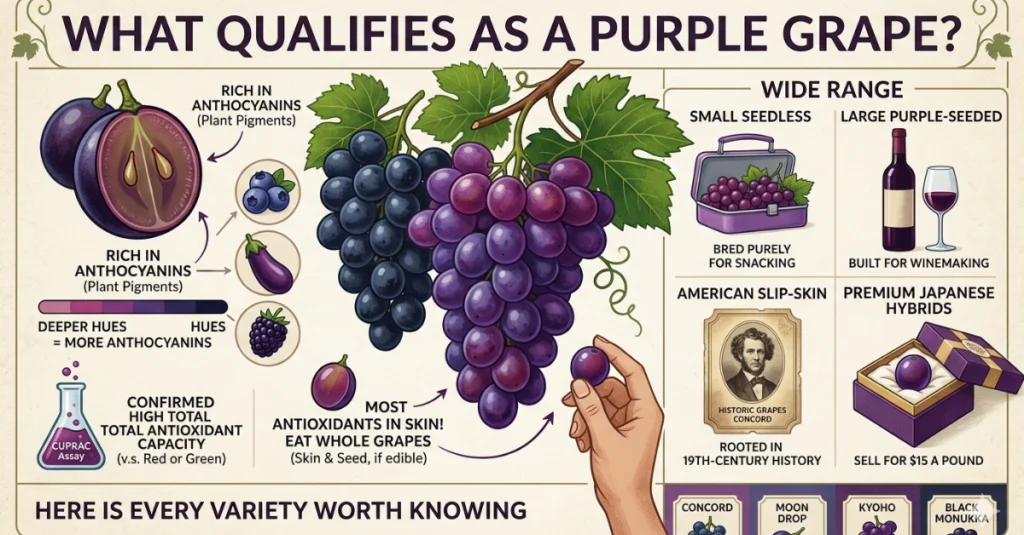
The grape purple color comes from anthocyanins — plant pigments that also drive the deep hues in blueberries, eggplant, and blackberries. The darker the skin, the more anthocyanins it carries.
A CUPRAC assay study published in PMC confirmed that Concord and purple grapes carry significantly higher total antioxidant capacity than red or green grapes tested under identical conditions. Most of that antioxidant activity sits in the skin, which means eating whole grapes, skin and all, captures the full benefit.
The term “purple grape” spans a wide range:
- Small seedless purple grapes bred purely for snacking
- Large purple-seeded grapes are built for winemaking.
- American slip-skin classics rooted in 19th-century history
- Premium Japanese hybrids that sell for $15 a pound
Here is every variety worth knowing.
The 8 Best Purple Grape Varieties
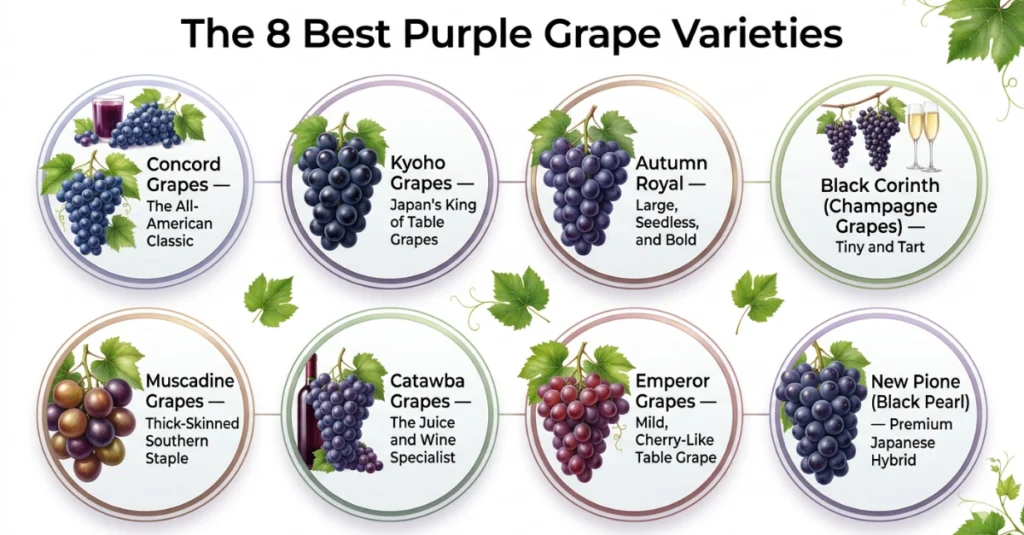
1. Concord Grapes — The All-American Classic
Ephraim Wales Bull planted over 22,000 seedlings on his Massachusetts farm before finding the one vine that changed American food history. He introduced Concord grapes to the market in 1854, and they won first prize at the Boston Horticultural Society Exhibition in 1853. Today, Washington State accounts for nearly half of the 400,000 tons of annual US production.
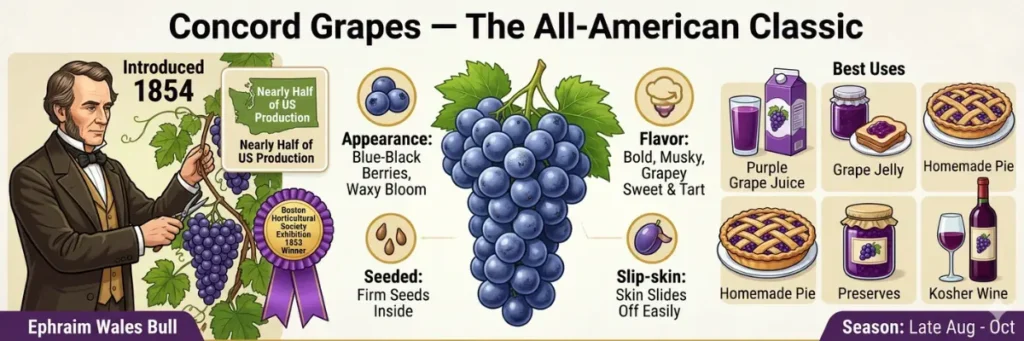
Appearance: Round, medium-sized, blue-black berries with a waxy white bloom you can rub off with your thumb.
Flavor: Bold, musky, intensely “grapey” — the flavor you recognize from Welch’s grape juice. Slightly tart with deep sweetness underneath. This is the dark purple grape most Americans picture when the word “grape” comes up.
Seeds: Seeded, with fairly firm seeds.
Slip-skin: Yes. The skin comes off easily from the green pulp with a gentle squeeze.
Best uses:
- Purple grape juice and grape jelly production
- Homemade preserves and grape pie
- Kosher and sacramental wine
- Natural food coloring
Season: Late August through October across New York, Michigan, Washington, and the Lake Erie belt.
2. Kyoho Grapes — Japan’s King of Table Grapes
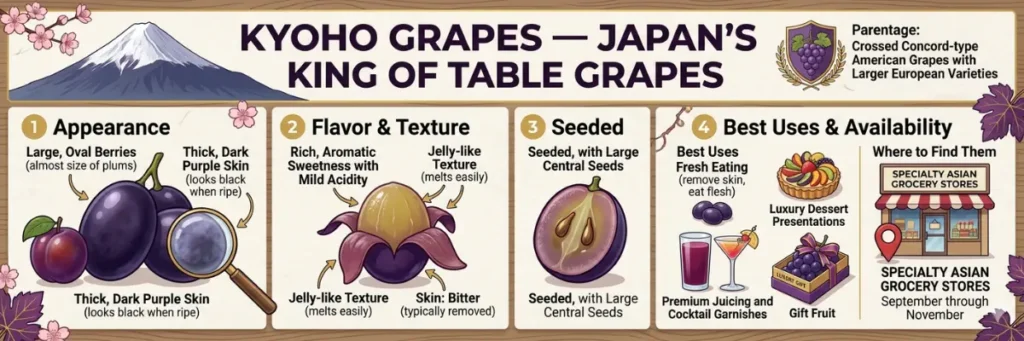
Japanese breeders created Kyoho grapes by crossing Concord-type American grapes with larger European varieties, officially naming them in 1942. The name means “giant mountain peak,” which refers to both Mount Fuji and the grape’s large size. Today, Kyoho makes up about a third of Japan’s table grape production and is the most popular purple grape in Asia.
Appearance: Large, oval berries that are almost the size of plums, with thick, dark purple skin that looks nearly black when fully ripe.
Flavor: Rich, aromatic sweetness with mild acidity. The flesh has a jelly-like texture that melts easily. The skin tastes bitter, so most people remove it before eating.
Seeds: Seeded, with large central seeds.
Best uses:
- Fresh eating (remove skin, eat flesh)
- Luxury dessert presentations
- Premium juicing and cocktail garnishes
- Gift fruit: Kyoho grapes are often sold as luxury gifts in Japan, packaged especially for giving.
Where to find them: Specialty Asian grocery stores in the US, September through November.
3. Autumn Royal — Large, Seedless, and Bold
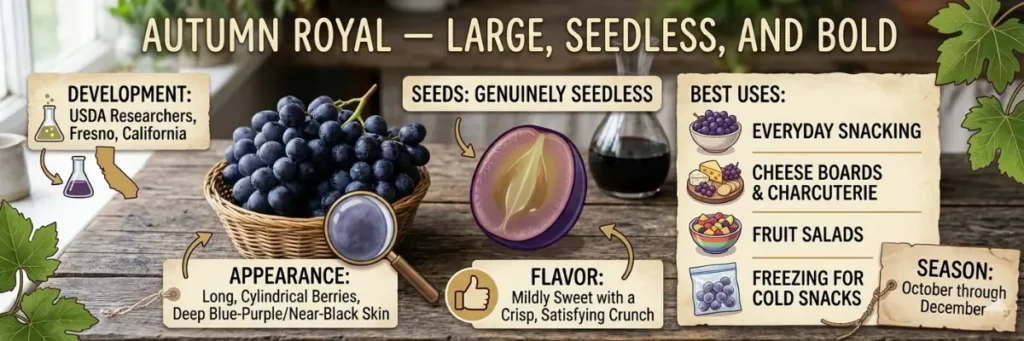
Autumn Royal was developed by USDA researchers in Fresno, California, to fill a gap left by other varieties. These are large, seedless purple grapes that stay fresh into December.
Appearance: Long, cylindrical berries with deep blue-purple to near-black skin. One of the most eye-catching purple grape varieties in any produce section.
Flavor: Mildly sweet with a crisp, satisfying crunch. Less musky than Concord, cleaner finish than Kyoho.
Seeds: Genuinely seedless.
Best uses:
- Everyday snacking
- Cheese boards and charcuterie platters
- Fruit salads
- Freezing for cold snacks
Season: October through December. Autumn Royal is one of the few fresh dark purple grapes late in the year.
4. Black Corinth (Champagne Grapes) — Tiny and Tart
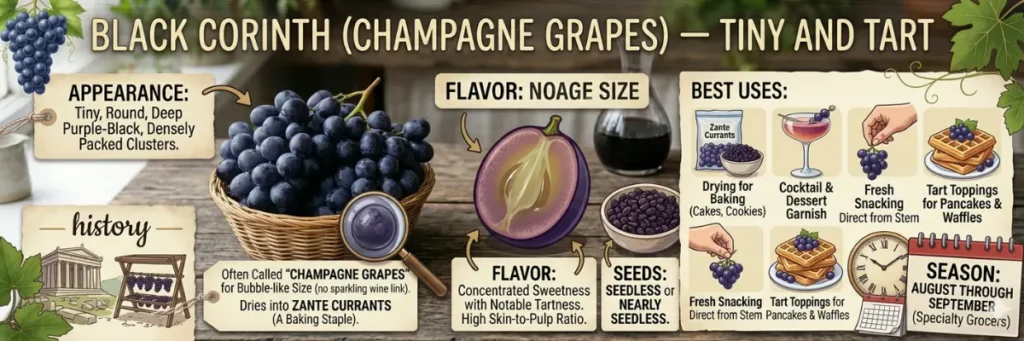
Black Corinth grapes are often called “Champagne grapes,” which can be confusing since they have nothing to do with sparkling wine. The nickname comes from their tiny size, as the berries look like little bubbles.
These same grapes dry into Zante currants, which appear in baking recipes worldwide.
Appearance: Tiny, round, deep purple to near-black berries that grow in densely packed clusters.
Flavor: Concentrated sweetness with noticeable tartness. The skin-to-pulp ratio is high, intensifying the flavor per berry.
Seeds: Seedless or nearly seedless.
Best uses:
- Drying into Zante currants for baking
- Cocktail and dessert garnishes
- Fresh snacking directly from the stem
- Tart toppings for pancakes and waffles
Season: August through September at specialty grocers.
5. Muscadine Grapes — Thick-Skinned Southern Staple
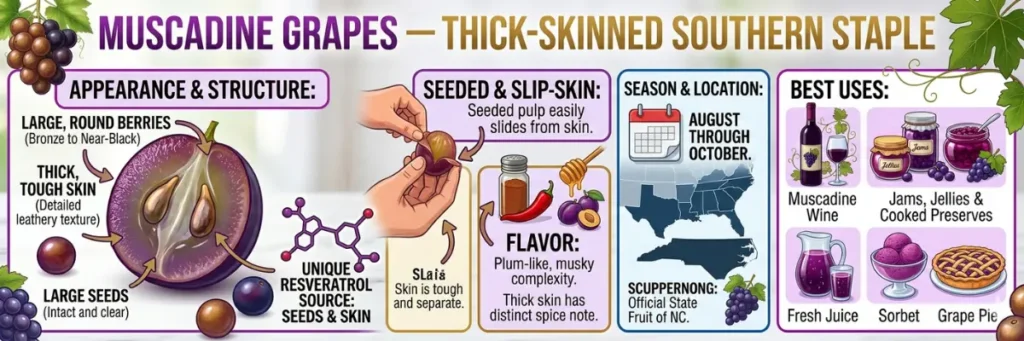
Muscadine grapes (Vitis rotundifolia) grow natively across the American Southeast and thrive in heat and humidity where European varieties struggle. Purple Muscadine grapes stand apart from every other variety on this list in one important way — their seeds contain resveratrol in addition to their skins, giving them a broader polyphenol profile than most dark purple grapes.
Appearance: Large, round berries with thick, tough skins. Colors range from bronze to near-black. The Scuppernong, a well-known Muscadine sub-variety, is the official state fruit of North Carolina.
Flavor: Earthy, spicy, intensely sweet — with complexity that ranges from plum-like to musky. The thick skin carries a distinct spice note that surprises first-time eaters.
Seeds: Seeded, with a slip-skin that separates easily.
Best uses:
- Muscadine wine
- Jams, jellies, and cooked preserves
- Fresh juice
- Grape sorbet and pies
Season: August through October across the American Southeast.
6. Catawba Grapes — The Juice and Wine Specialist
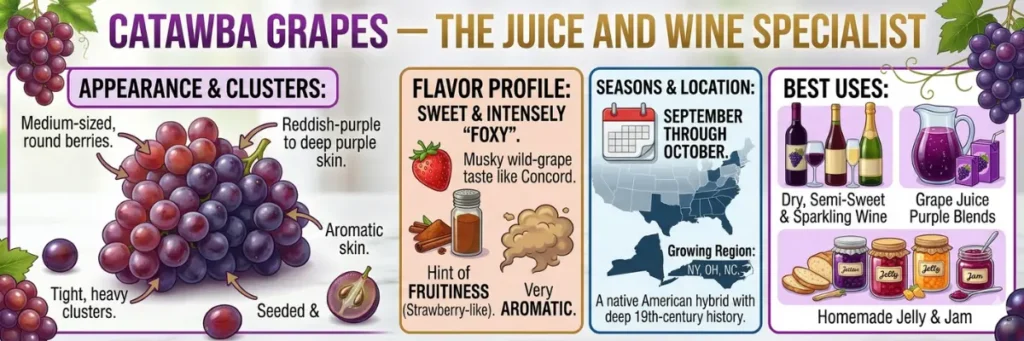
Catawba is a natural American hybrid with deep roots in 19th-century US winemaking. It grows primarily in New York, Ohio, and North Carolina, and the skin ranges from reddish-purple to deep purple at full ripeness.
Appearance: Medium-sized, round berries with tight, heavy clusters.
Flavor: Sweet and intensely “foxy,” with the same musky wild-grape taste as Concord, but with a hint of fruitiness that’s a bit like strawberry. Very aromatic.
Seeds: Seeded.
Best uses:
- Dry, semi-sweet, and sparkling wine
- Grape juice purple blends
- Homemade jelly and jam
Season: September through October.
7. Emperor Grapes — Mild, Cherry-Like Table Grape
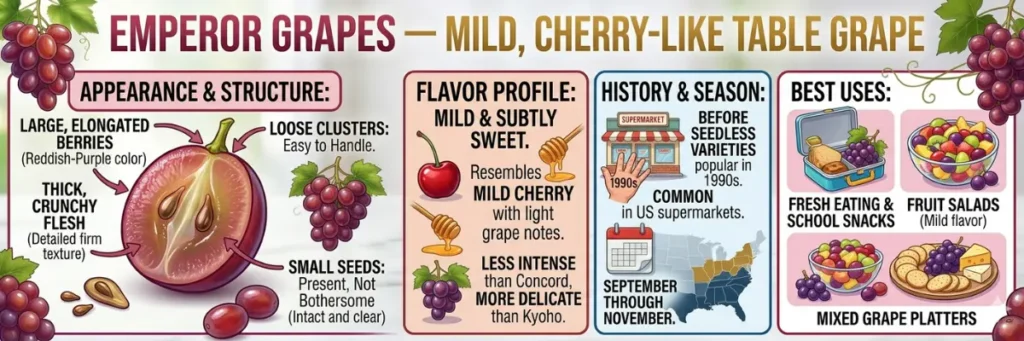
Emperor grapes were common in US supermarkets before seedless varieties became popular in the 1990s. Their color is more crimson-purple, not as dark as Concord or Kyoho, and is closer to a purple-red shade.
Appearance: Large, elongated berries with reddish-purple skin and a thick, crunchy flesh. Clusters grow loose and easy to handle.
Flavor: Mild and subtly sweet — less intense than Concord, more delicate than Kyoho. Resembles a mild cherry with light grape notes.
Seeds: Small seeds that are present but not bothersome.
Best uses:
- Fresh eating and school snacks
- Fruit salads where a milder grape flavor fits better
- Mixed grape platters
Season: September through November.
8. New Pione (Black Pearl) — Premium Japanese Hybrid
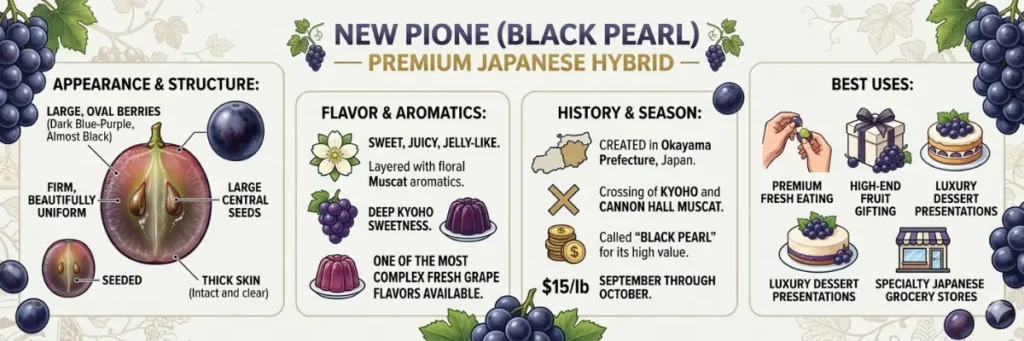
New Pione is a grape from Okayama Prefecture, Japan’s leading grape-growing area. It was created by crossing Kyoho and Cannon Hall Muscat. These grapes can sell for up to $15 a pound in specialty Japanese markets, which is why they’re called “Black Pearl.”
Appearance: Large, oval berries with dark blue-purple skin that looks almost black. Firm, beautifully uniform.
Flavor: Sweet, juicy, jelly-like — with floral Muscat aromatics layered over deep Kyoho sweetness. One of the most complex fresh grape flavors available anywhere.
Seeds: Seeded with large central seeds.
Best uses:
- Premium fresh eating (remove skin, eat flesh)
- High-end fruit gifting
- Luxury dessert presentations
Where to find them: Specialty Japanese grocery stores and upscale markets. September through October.
Purple Grape Variety Comparison Table
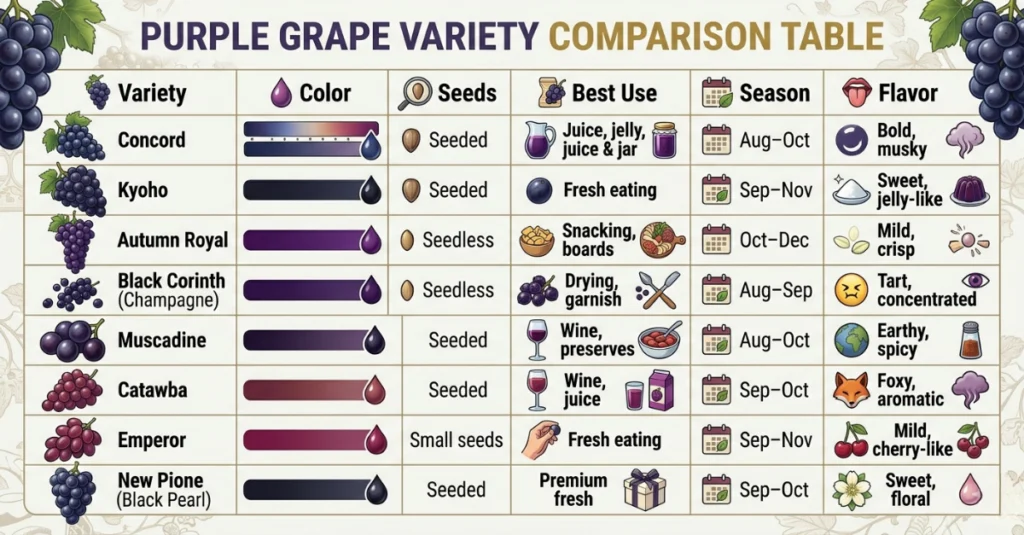
| Variety | Color | Seeds | Best Use | Season | Flavor |
| Concord | Blue-black | Seeded | Juice, jelly | Aug–Oct | Bold, musky |
| Kyoho | Near-black | Seeded | Fresh eating | Sep–Nov | Sweet, jelly-like |
| Autumn Royal | Deep purple | Seedless | Snacking, boards | Oct–Dec | Mild, crisp |
| Black Corinth | Dark purple | Seedless | Drying, garnish | Aug–Sep | Tart, concentrated |
| Muscadine | Purple-black | Seeded | Wine, preserves | Aug–Oct | Earthy, spicy |
| Catawba | Reddish-purple | Seeded | Wine, juice | Sep–Oct | Foxy, aromatic |
| Emperor | Crimson-purple | Small seeds | Fresh eating | Sep–Nov | Mild, cherry-like |
| New Pione | Near-black | Seeded | Premium fresh | Sep–Oct | Sweet, floral |
How to Pick the Right Purple Grape for Your Needs
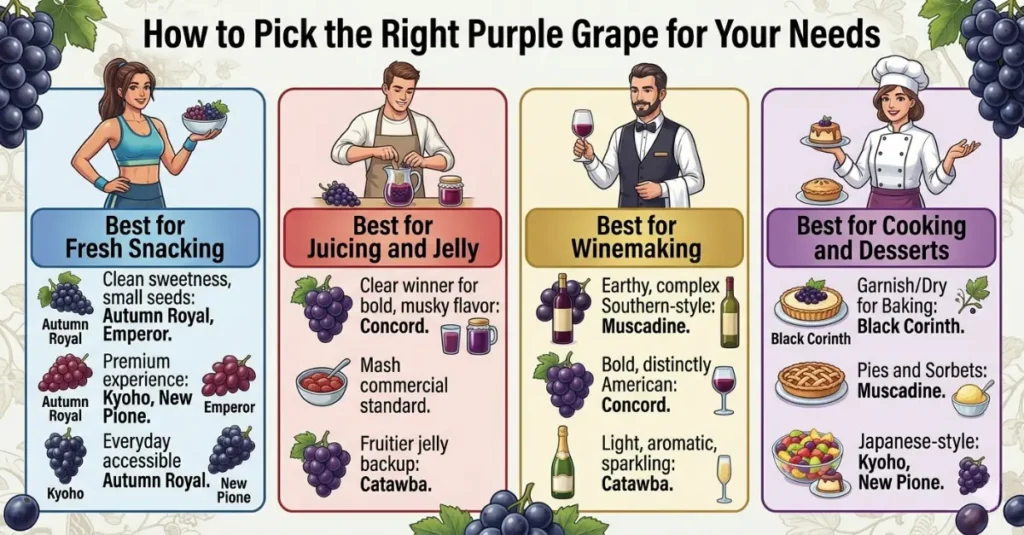
Best for Fresh Snacking
Autumn Royal or Emperor grapes both offer a clean sweetness and don’t have large, bothersome seeds.
For a premium experience, Kyoho and New Pione sit at the top. But for everyday accessible snacking, Autumn Royal wins on quality and availability.
Best for Juicing and Jelly
Concord grapes are the clear winner. Their bold, musky flavor stands up better to juicing and cooking than any other variety. That’s why almost all commercial purple grape juice tastes like Concord.
Catawba works as a backup for a slightly fruitier jelly.
Best for Winemaking
- Muscadine for earthy, complex Southern-style wine
- Concord for bold, distinctly American style
- Catawba for light, aromatic, and sparkling styles
Best for Cooking and Desserts
Use Black Corinth as a garnish or dry them into currants for baking. Muscadine grapes are great for pies and sorbets. Kyoho and New Pione work well in Japanese-style desserts, where the whole grape adds both flavor and visual appeal.
Green vs. Purple Grapes: What’s the Real Difference?
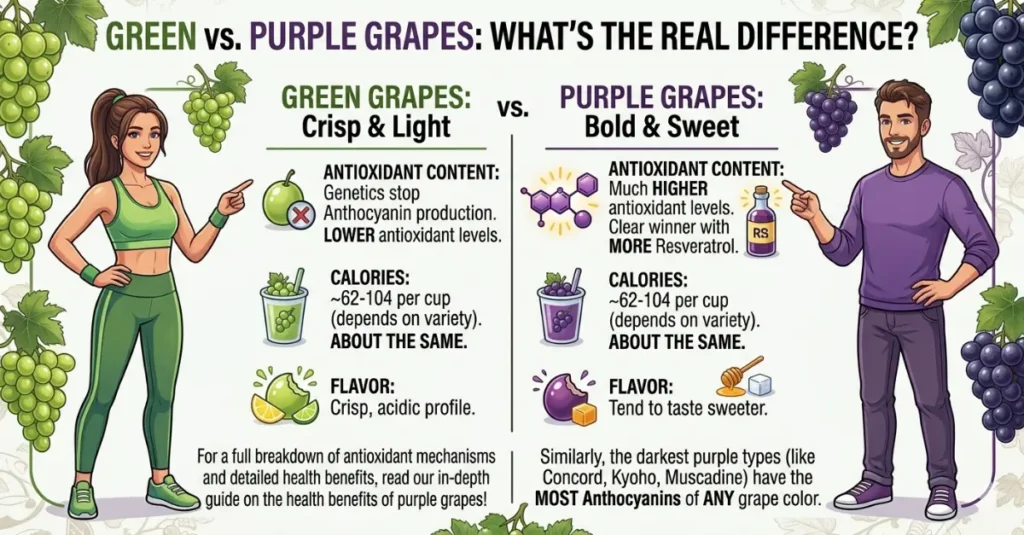
This comparison comes up constantly, so here is the research-backed answer.
Antioxidant content: Purple grapes are the clear winner. Green grapes have a genetic mutation that stops them from making anthocyanins, so they have much lower antioxidant levels. Purple grapes also have more resveratrol than green ones.
Calories: Both types have about the same amount, usually between 62 and 104 calories per cup, depending on the variety.
Flavor: Purple and dark grape purple varieties tend to taste sweeter. Green grapes carry a crisper, more acidic profile.
For a full breakdown of what those antioxidant differences actually do inside your body, our guide on the health benefits of purple grapes covers every mechanism in detail.
Similarly, when you compare red and purple grapes, the darkest purple types like Concord, Kyoho, and Muscadine have the most anthocyanins of any grape color.
When Do Purple Grapes Come Into Season?
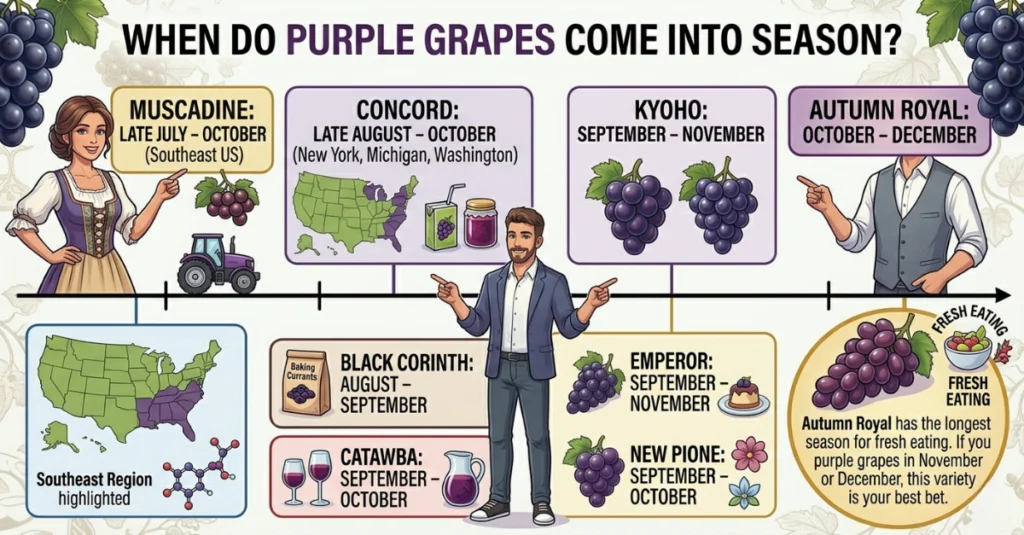
- Muscadine: Late July – October (Southeast US)
- Concord: Late August – October (New York, Michigan, Washington)
- Black Corinth: August – September
- Catawba: September – October
- Kyoho: September – November
- Emperor: September – November
- New Pione: September – October
- Autumn Royal: October – December
Autumn Royal has the longest season for fresh eating. If you want purple grapes in November or December, this variety is your best bet.
Where to Buy Authentic Purple Grape Varieties
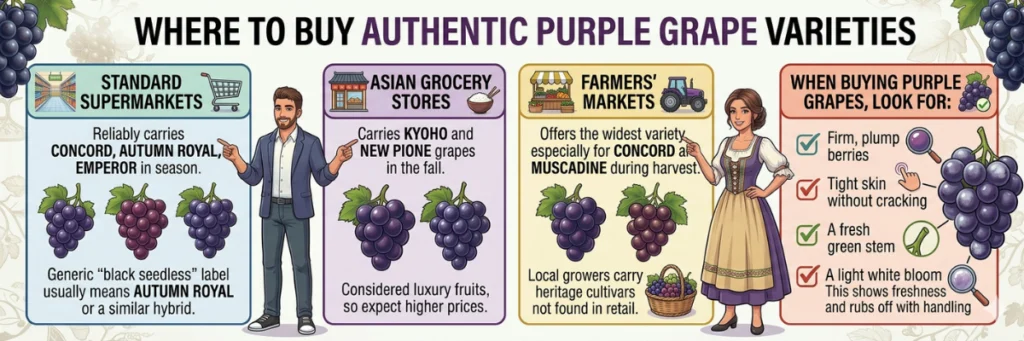
Standard supermarkets carry Concord, Autumn Royal, and Emperor reliably in season. The generic “black seedless” label usually means Autumn Royal or a similar hybrid.
Asian grocery stores carry Kyoho and New Pione grapes in the fall. These are considered luxury fruits in their home countries, so expect higher prices.
Farmers’ markets offer the widest variety, especially for Concord and Muscadine during harvest season. Local growers often carry heritage cultivars that never reach retail shelves.
When buying any purple grape, look for:
- Firm, plump berries with no soft spots
- Tight skin without cracking
- A fresh green stem
- A light white bloom on the skin. This waxy coating shows the grapes are fresh and will rub off with handling.
Can Dogs Eat Purple Grapes?

No. Dogs should not eat purple grapes or any type of grape.
All grape varieties carry compounds toxic to dogs. Ingestion causes acute kidney failure regardless of variety, quantity, or the presence of seeds. Even a small amount can trigger severe illness. If your dog eats grapes, contact a veterinarian or animal poison control immediately — do not wait for symptoms.
Purple Grape Juice vs. Whole Purple Grapes
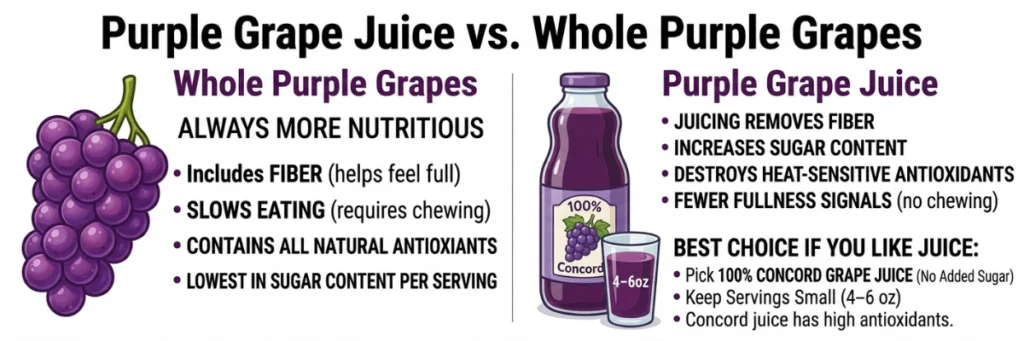
Whole purple grapes are always more nutritious than grape juice.
Juicing removes fiber, increases sugar content (sometimes doubling it per serving), and destroys some heat-sensitive antioxidants. Eating whole grapes also means you have to chew, which helps you feel full and slows down how fast you eat.
If you like juice, pick 100% Concord grape juice that’s purple and has no added sugar. Try to keep servings to 4–6 ounces. Concord grape juice has the most antioxidants of any grape juice you can buy.
Conclusion
Each purple grape variety has its own strengths. Concord is best for bold juice and jelly. Kyoho and New Pione are top choices for premium fresh eating. Autumn Royal lets you enjoy fresh grapes into winter. Muscadine has the most polyphenols. Black Corinth packs a lot of flavor into a tiny berry.
The best grape for you depends on what you want to do with it, but no matter which variety you choose, be sure to eat the skin. That’s where you’ll find most of the anthocyanins, resveratrol, and quercetin. If you peel a dark purple grape, you lose the very nutrients that make it healthy. For the full picture on what those compounds do for your cardiovascular health, brain, bones, and immunity, read our complete breakdown of the health benefits of purple grapes.
FAQ’s
What Is the Sweetest Purple Grape?
Kyoho and New Pione are the sweetest purple grapes for fresh eating, with jelly-like flesh and rich natural sweetness. For a good mix of sweetness and crunch from the supermarket, Autumn Royal is the best choice.
Are Seedless Purple Grapes Less Nutritious?
No. Seedless and seeded purple grapes have similar nutritional profiles in their skins and flesh. Seeded grapes do provide extra polyphenols from the seeds, like proanthocyanidins and vitamin E, but for most people, the difference is small. The skin remains the main source of anthocyanins and resveratrol across all types.
What Is the Difference Between Green and Purple Grapes Nutritionally?
Purple grapes carry significantly more antioxidants. The anthocyanin block in green grapes is genetic and complete — they simply cannot produce the pigment. For maximum polyphenol intake, the darkest purple grape varieties always win.
What Purple Grapes Work Best for Homemade Wine?
Use Muscadine grapes for complex Southern-style wine, Concord for a bold American flavor, and Catawba for the most versatile winemaking, including elegant sparkling wines.
What Are Purple Cotton Candy Grapes?
Purple cotton candy grapes are a hybrid created to taste like cotton candy. They are extremely sweet, have low acidity, and have an almost perfumed flavor. You can find them in both green and purple-tinted types. They have less antioxidant power than dark Concord-type grapes because lighter grapes have fewer anthocyanins.