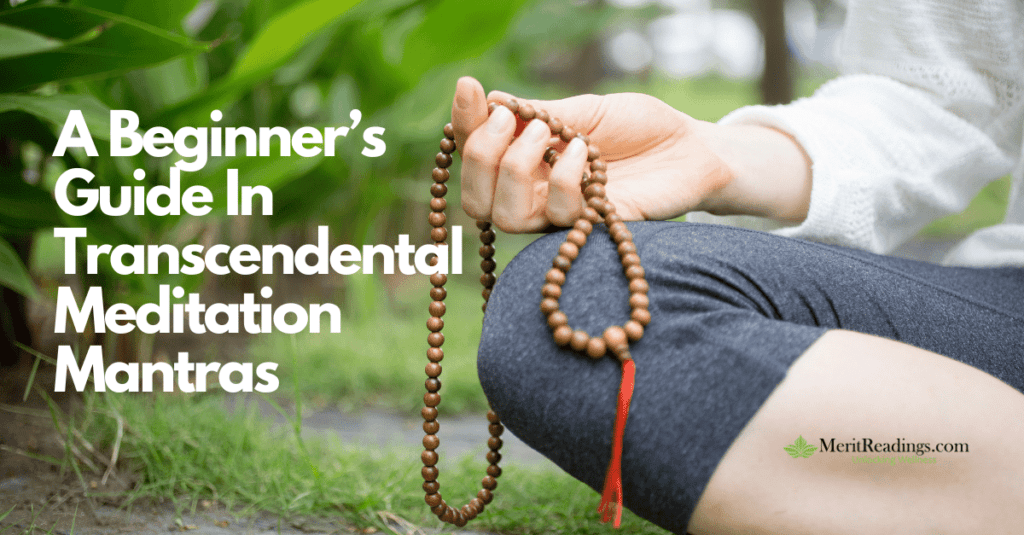
If you’re just getting started with Transcendental Meditation (TM), there’s one thing you’ll hear about again and again – transcendental meditation mantras. They sit at the heart of the TM practice and guide the mind into a calm, natural state. These mantras are not affirmations or chants. They are gentle sounds that help attention move inward without effort.
Many beginners feel curious or even confused about how mantras work. Some wonder why a single word can have such a strong effect during meditation. This is completely normal. When used correctly, a transcendental meditation mantra allows the mind to settle on its own, without force or control. Over time, this creates a deeper and more stable meditation experience.
In this guide, we break down how mantras are used in Transcendental Meditation and why they matter so much. You’ll learn about commonly shared mantras, how teachers explain their purpose, and simple tips to stay comfortable during practice. And if you’re looking for daily mantras to ignite your purpose, you’ll find those here too. These short, meaningful phrases can help set intentions, bring inner clarity, and give your day a gentle sense of direction.
- What is Transcendental Meditation (TM)?
- What is a Mantra in TM?
- How to Choose a Mantra
- Commonly known TM Mantras by Age and Gender
- Transcendental Meditation Mantra List (TM Mantras List)
- How Does the Mantra Work?
- Advice for New Practitioners: The First Steps to Use TM Mantras
- Why Are the Mantras Kept Secret?
- Benefits of Using a Mantra in TM
- Conclusion
- FAQ's
What is Transcendental Meditation (TM)?
Transcendental Meditation is one of the 12 types of meditation, and it’s both easy and effective. In this practice, you repeat a mantra in your mind to help you relax deeply and clear your mind. You practice TM for 20 minutes, twice a day, usually while sitting comfortably with your eyes closed. Because the practice is simple, the transcendental meditation tm technique is often recommended for beginners who want a calm and structured way to meditate without concentration or control.
Unlike morning mindfulness meditation or focused meditation, which require concentration and awareness, TM emphasizes the effortless repetition of a mantra for relaxation. The goal is to let your mind settle into a quiet, peaceful state.
What is a Mantra in TM?
A mantra in Transcendental Meditation is a sound or word that you repeat quietly during meditation. It doesn’t have a specific meaning; its job is to help your mind relax. The key is to repeat the mantra easily, without trying too hard to focus.
When you learn TM, your teacher will give you a special mantra as part of the transcendental meditation tm technique, chosen to support an effortless, comfortable meditation experience. The teacher chooses TM mantras by age and gender to ensure each mantra fits you and supports your meditation. The teacher keeps these mantras private, sharing them only with you.
How to Choose a Mantra
Many beginners wonder how to find your mantra for transcendental meditation, especially when starting their practice for the first time.
- Personal Connection: Pick a word or sound that feels calming and connects with you.
- Keep it simple: Choose a short one-word mantra that’s easy to repeat.
- No meaning needed: The mantra shouldn’t have any specific meaning; it’s all about helping you focus and relax.
- Get some guidance: If you’re learning TM or another tradition, it’s best to follow your teacher’s guidance to ensure the mantra fits with the practice.
The main thing is to find a mantra that helps you get into a calm, focused state.
Commonly known TM Mantras by Age and Gender
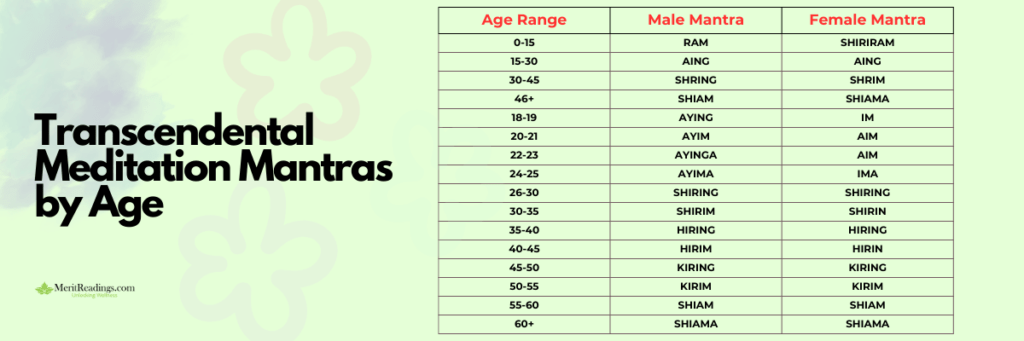
In Transcendental Meditation, a practitioner repeats a sound or word silently during meditation. The mantras used in Transcendental Meditation (TM) are personal. Many people ask what the 16 TM mantras are when researching Transcendental Meditation online. However, some well-known single-word mantras are commonly discussed for general understanding.
Most TM mantras are from Sanskrit, a language from India, and have been part of meditation for centuries. However, the mantras themselves often do not have specific meanings. Their purpose is to help guide the mind into a restful state. The key is to repeat the one-word mantra effortlessly without trying too hard to focus.
These are typically simple Sanskrit words or mantra syllables. Here is a list of Transcendental Meditation mantras commonly used, associated with different age groups
Transcendental Meditation Mantra List (TM Mantras List)
| Age Range | Male Mantra | Female Mantra |
| 0-15 | RAM | SHIRIRAM |
| 15-30 | AING | AING |
| 30-45 | SHRING | SHRIM |
| 46+ | SHIAM | SHIAMA |
| 18-19 | AYING | IM |
| 20-21 | AYIM | AIM |
| 22-23 | AYINGA | AIM |
| 24-25 | AYIMA | IMA |
| 26-30 | SHIRING | SHIRING |
| 30-35 | SHIRIM | SHIRIN |
| 35-40 | HIRING | HIRING |
| 40-45 | HIRIM | HIRIN |
| 45-50 | KIRING | KIRING |
| 50-55 | KIRIM | KIRIM |
| 55-60 | SHIAM | SHIAM |
| 60+ | SHIAMA | SHIAMA |
These mantras are easy to remember. They help the mind find a peaceful rhythm during meditation.
How Does the Mantra Work?
In TM, the mantra helps calm the mind. When you sit down to meditate, you close your eyes and start repeating the mantra silently to yourself. Over time, your thoughts will naturally slow down, and you will feel more relaxed. If your thoughts begin to drift, simply guide your attention back to the mantra.
For example, imagine Sarah, who is just learning how to practice transcendental meditation. She finds a comfortable spot to sit quietly and begins repeating her mantra, “AING.” At first, her thoughts are all over the place—she thinks about her to-do list, her recent conversations, and the noise outside. But as she keeps saying “AING” softly, she starts to feel calm.
Suddenly, she remembers her upcoming work presentation. Instead of getting upset, she notices the thought and goes back to saying “AING.” After a little while, she realizes that her thoughts are fading, and her mind is getting quieter. This helps her feel more relaxed.
The key to Transcendental Meditation is that you don’t need to force anything. The process is easy, and you let your mind follow the mantra into a peaceful, deeper state of awareness.
Advice for New Practitioners: The First Steps to Use TM Mantras
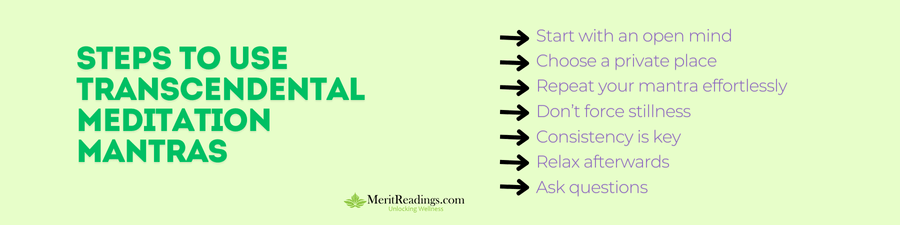
As a teacher of TM, I have a few points and suggestions for beginners. These tips will help you start your TM practice smoothly.
1. Start with an open mind:
Remember, meditation is a process, and each experience is different. Be receptive to the process and do not have any definition for the outcomes.
2. Choose a private place:
Look for a peaceful area where you can meditate for 20 minutes without any distractions. You don’t need to sit in a special posture—just make sure you’re relaxed.
3. Make the space feel calm:
Adding a gentle scent to your space can make your TM practice more relaxing. You can use mantra essential oils or mantra-scented candles to bring a soft smell that helps you feel at ease and focus on your mantra, making meditation feel even smoother and more peaceful.
4. Repeat your mantra effortlessly:
Don’t worry about saying the mantra perfectly or focusing too hard on it. Simply choose a mantra from the TM mantras list and let the sound guide your mind into a peaceful state.
5. Don’t force stillness:
It’s natural for thoughts to come and go during meditation. Don’t try to block them out—just gently return to your mantra whenever you notice your mind has wandered.
6. Consistency is key:
Practice TM regularly, twice a day for 20 minutes. With time, you’ll find it easier to settle into the rhythm of the mantra and experience deeper relaxation.
7. Relax afterwards:
After your 20 minutes of TM, take a moment to sit quietly with your eyes still closed. This transition back to regular activity allows your body to adjust and enhances the benefits of your practice.
8. Expanding Your Mantra:
Wait until you’ve practiced TM regularly for six months before introducing any changes to your mantra. This consistent practice, twice a day, is key to building a solid foundation. After this period, and only if you’ve maintained regular sessions, you may consider using an expanded mantra. Begin by softly whispering this new mantra, allowing yourself to adjust gradually without hurrying the process.
9. Ask questions:
As you begin, it’s important to feel comfortable with your practice. If you have questions, feel free to bring them up with your instructor, such as:
- How should I sit while repeating the mantra?
- What should I do if my mind keeps wandering during meditation?
- Can I switch my mantra if I feel it isn’t working for me?
By following these tips, you’ll have a solid foundation for your TM practice and get the most out of your mantra meditation.
Why Are the Mantras Kept Secret?
Each practitioner traditionally keeps the mantra private. The TM movement thinks that a mantra is a personal sound that connects to each person. Keeping it private helps maintain a special bond between the person and their meditation practice.
Many TM mantras have become well-known over the years. It is important to understand that these mantras are not sacred. Instead, they are tools to help you find inner calm.
Benefits of Using a Mantra in TM

When you repeat a mantra from a transcendental meditation mantras list, it can help you enjoy benefits like:
- Reduced Stress: The quieting of the mind during TM can help lower stress levels.
- Improved focus: As your mind settles, you may find that your ability to focus improves.
- Better sleep: Many practitioners report that regular practice of TM leads to deeper, more restful sleep.
- Greater mental clarity: TM can help clear the mental clutter, allowing for a more peaceful and focused state of mind.
Conclusion
Starting Transcendental Meditation (TM) and using transcendental meditation mantras can help you relax, clear your mind, and find calm. Newcomers should know that a mantra is a useful tool for managing thoughts and improving meditation lessons. As stated, TM is about finding calm and letting thoughts go, no matter if you use a popular or personal mantra.
It can also be helpful to explore a TM mantras list to understand commonly discussed mantras, though a certified teacher always assigns your personal mantra. How you feel about practice will vary, so it is best to give yourself time to develop. With dedication and practice, you may find that TM brings you greater peace, clarity, and relaxation in your daily life. Happy meditating!
Disclaimer : This content is for informational purposes only and is not intended to teach or provide instruction on Transcendental Meditation. It is not a substitute for the official Transcendental Meditation program or instruction. TM and Transcendental Meditation are trademarks of the Maharishi Foundation.
FAQ’s
Q: What is a Mantra Generator in Meditation?
A: A mantra generator is an online tool that helps you find a mantra based on your needs or personality. It matches you with a word or sound to make meditation easier. In Transcendental Meditation (TM), your instructor personally selects a mantra for you, considering factors like your age and gender.
Q: Where Can I Find a Mantra Generator?
A: You can find mantra generators online on websites like:
- Mindworks (mindworks.org) – They offer guided meditation resources and sometimes include mantra generators.
- Meditation Sanctuary (meditationsanctuary.com) – Offers various meditation tools, including mantra generators.
- Chopra (chopra.com) – A wellness site that occasionally provides resources for finding a mantra or mantra meditations.
Q: Can I change my mantra if I feel it’s not effective?
A: Your teacher almost always connects your mantra to your personality. On the other hand, if your mantra doesn’t feel right for you, than it is quite alright to speak up to your instructor. They may help you determine whether you need a change or not.
Q: What’s the difference between mantra and affirmation?
A: While both mantras and affirmations involve repeating words or phrases, they serve different purposes.
- A mantra in Transcendental Meditation (TM) doesn’t have a specific meaning. Its goal is to help quiet the mind and bring you into a relaxed state. It’s more about letting go and allowing the sound to guide you.
- An affirmation, on the other hand, is a positive statement meant to create change or reinforce a belief. Affirmations are often goal-oriented and focus on positive thoughts or intentions, whereas mantras in TM are used to simply clear the mind and promote relaxation, with no specific aim beyond that.
Q: Is TM safe for everyone?
A:TM is relatively safe for most of the population. In any case, if you have certain health problems or suffer from mental illnesses, it is wise to ask your physician before beginning it. They will be able to tell you if TM is appropriate for you.
Q: Is it acceptable for children to practice TM?
A: Yes! Children can practice TM! Most of the families have noticed improvements in their child’s concentration as well as a quiet mind as a result of TM. It is important to give them teaching styles appropriate for the children’s age.
Q: Are there organized or social activities of TM with a group which I can participate?
A: Sure! There are many group meditations and retreats organized by TM centers. These occasions are excellent for meeting new friends and enriching your practice. Please contact your local TM center to learn what kind of events they run.